
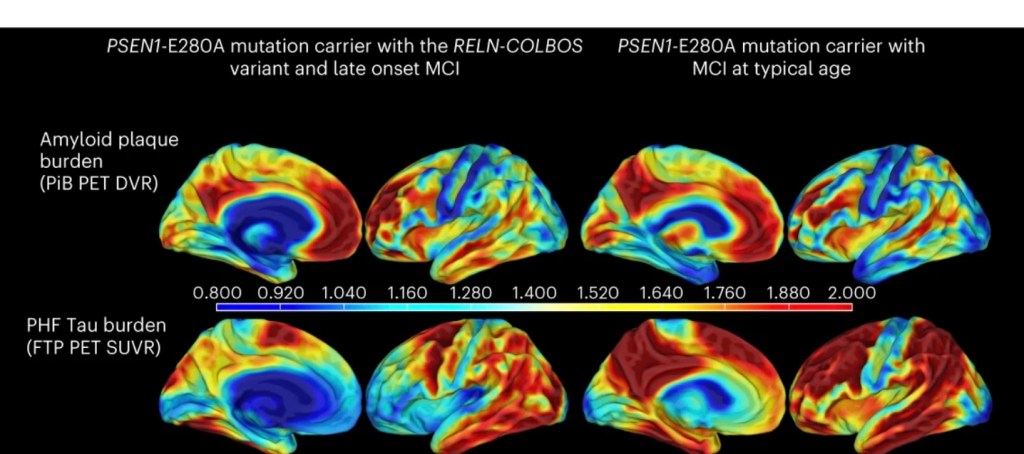
There is a big excitement about Nature paper by Lopera et al. published on May 15. Development of Alzheimer disease and resulting dementia involves the emergence and growth of amyloid plaque that impedes the function of neurons. After regulatory dysregulation leads to plaque formation, the symptoms are hard to stop and reverse. However, a gain of function mutation of RELN gene seems to delay the onset of dementia by more than 20 years WITHOUT decreasing the plaque. This is documented for rare cases in which AD causing plaque forms as a result of a missense mutation of PSEN1 gene coding a key protein in NOTCH signaling pathway. This mutation is a major cause of early AD, with average age of onset of 44 and full dementia 5 years later, with thousands of such cases. Two independent subjects with that mutation had AD onset delayed to late 60 ties. The protective mutation found in this paper does not impede the plaque growth, but it yields GOF, gain of function, of RELN, more precisely the increased affinity of binding to heparin, cell membrane protein, and probably other glycosaminoglycan membrane proteins as well. In terms of AD pathology, GOF of RELN did not alter the amyloid plaque burden, but it significantly reduced tau burden that ordinarily follows. This points to a potentially druggable interaction that could mimic the protective effect of GOF mutation of RELN.
The authors give a necessary caveat “Because the comparative neuropathology was conducted in a relatively low number of cases, the results should not be considered definitive and they are only helpful as informative to generate hypotheses.”
Lopera, F., Marino, C., Chandrahas, A.S. et al. Resilience to autosomal dominant Alzheimer’s disease in a Reelin-COLBOS heterozygous man. Nat Med 29, 1243–1252 (2023). https://doi.org/10.1038/s41591-023-02318-3
 Jieun Jeong (정지은), Ph.D.