
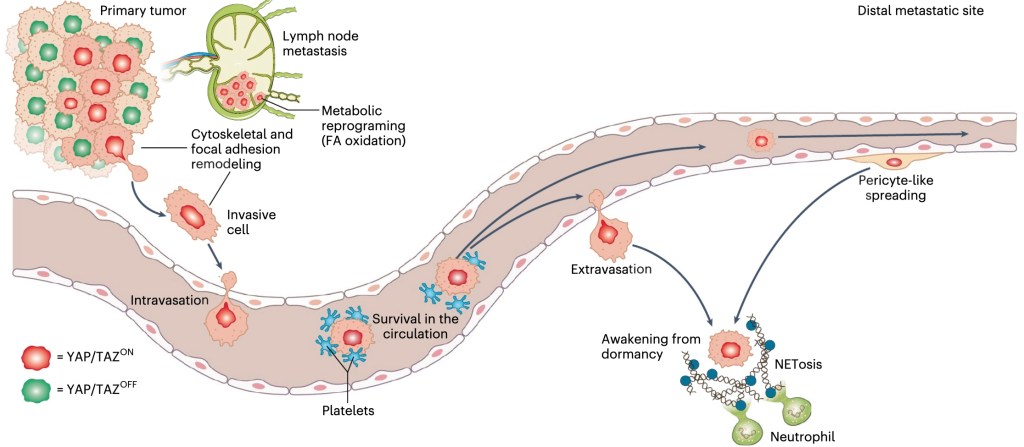
YAP/TAZ can be a trigger in “marine mines” laid by tumors to create delayed metastasis. This is but one of many cancer mechanisms involving YAP/TAZ (a central component of Hippo pathway) reviewed by Piccolo et al. in YAP/TAZ as master regulators in cancer, Nature Cancer, Dec 2022. A marine mine is laid in the sea and stays there quietly, or floats until it is triggered by a collision and explodes. Solid tumors can release single cells from their matrix. Such a cell can enter a dormant state in the absence of stromal signals and enter the bloodstream; eventually it exits the bloodstream and then it remains dormant until it collides with a DNA net created by a neutrophil, NETs that may kill infecting bacteria. As constricting strands of DNA cause a strong mechanical stress that deforms cytoskeleton, this stress activates YAP/TAZ complex through mechanosignaling. Activated YAP/TAZ enters the nucleus and reprograms the cell to a proliferating and invasive state.
The benign purpose of mechanosignaling allows a cell to adapt when it is overcrowded in tissue matrix: the cell becomes very flexible and relocates. This allows organs to grow, but unfortunately, it allows a cancer cell to escape NETs in an aggressive mode.
I got interested in this review because of an analysis involving YAP1 in SCLC, and indeed, it provides the wider context very well, and illustrates it beautifully.
 Jieun Jeong (정지은), Ph.D.