
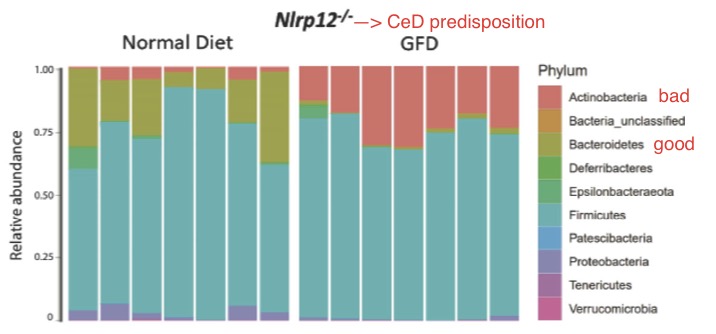
Recent paper by Morrison et al. shows that gluten-free diet (GFD) can cause dysbiosis with consequences like intestinal inflammation, food allergies etc. 25-50% of people have genetic susceptibility to Celiac Disease (CeD) that in a minority of cases leads to this disease, and GFD is currently the only treatment. How about the people with the predisposition but no CeD? Is GFD a useful precaution or an unnecessary risk?
Morrison et al. documents a risk of GFD in “NLRX1 Deficiency Alters the Gut Microbiome and Is Further Exacerbated by Adherence to a Gluten-Free Diet”, Frontiers in Immunology, Vol.13, Apr. 2022. This project is based on observation of mice fed normal and GFD diet, with mice bred to be “normal” or with CeD predispositions. In each case, GFD diet led to decrease in beneficial bacteria in the gut, and replacement with pro-inflammatory bacteria. Additionally, the authors document cell-to-cell signaling that is involved, which is an important biological contribution with medical implications.
A significant caveat is that the comparison is between a normal diet formulated for laboratory mice, and its GFD variant, which was unnecessarily damaging to proper gut biota. Humans do create diets with wheat products that leads to dysbiosis and healthy diets with no grains other than rice (which is gluten free), as in most of East and South Asia.
 Jieun Jeong (정지은), Ph.D.