
“Atf3 defines a population of pulmonary endothelial cells essential for lung regeneration” by Niethamer at al. 2022 https://doi.org/10.1101/2022.10.14.512212 describes an important discovery in which reanalysis of data previously published by those researchers had a key role.
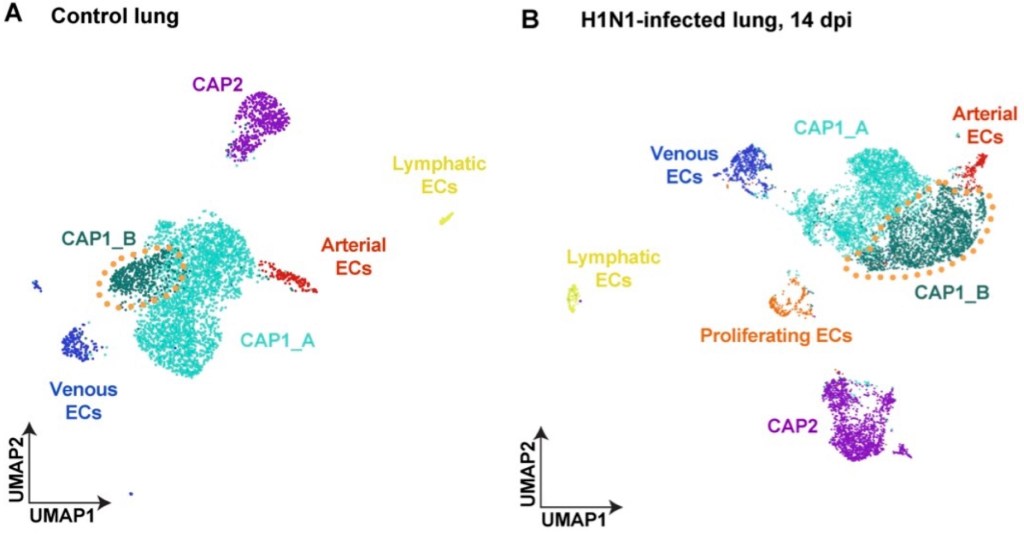
Lung performance relies on proper structure of alveoli, tiny niches in lung where the gas exchange occurs, and these tiny organs are often damaged, e.g. by infections, and subsequently regenerated. A major part of alveoli consists of capillary vessels with two known types of cells, CAP1 and CAP2, and CAP1 has main role in regeneration. An improved analysis of single cell mRNA data showed that CAP1 has two subtypes CAP1_A and CAP1_B, with a number of markers specific to CAP1_B. Among those markers, Atf3 was already known as necessary for proper regeneration in nerves, kidney and intestines. New experiments validated the identity and importance of CAP1_B, showing that this subtype expands during lung healing that follows a damage and increases expression of the genes responsible for proliferation and differentiation, e.g. from Wnt, Notch and mitogen pathways. Moreover, Atf3 is indispensable for this process.
Restoration of lung function is a huge issue and discoveries in this directions are very exciting.
For me, it is interesting how quickly single cell analysis changes, in this case, from 2020 to 2022, and which novel elements lead to the improvement. Because of small number of identified UMIs and possible intermittent gene expression, it is normal that marker genes are found in less than 50% of cells representing a subtype, thus identification of subtypes has a room for improvement or trying different existing workflows.
 Jieun Jeong (정지은), Ph.D.